My Passion For Invention And Better Solutions.
Throughout my life, I have always been interested in improving the way people learn, work, and experience everyday activities. When I see a challenge, I naturally look for a better solution.
This is the same mindset behind the 3rd Wheel Conversion Kit. I saw people struggling with walk-behind trimmers, so I created a solution to make them easier to control and more comfortable to operate.
Years earlier, I applied the same philosophy to music education. I developed an advanced online guitar learning system designed to help students learn step by step, from the fundamentals of reading music to playing more advanced techniques.My goal was not to teach students to simply copy movements. My goal was to help them understand music,
build strong foundations, and become independent learners.
A five-year-old beginner and an advanced player should both be able to learn at their own level. With the right teaching method, patience, and practice, students can continue improving from basic skills all the way to advanced music.
I believe true education creates understanding. Whether it is music, technology, or an invention, the purpose is the same: create something that helps people become better.
How I Invented The 3rd Wheel Conversion Kit (WBTAP)
Every invention starts with a problem. For me, the idea behind the 3rd Wheel Conversion Kit started from my own experience using a walk-behind string trimmer.
I experienced the same frustration many owners face. A walk-behind trimmer rides mainly on two rear wheels, requiring the operator to constantly manage the weight, balance, and movement of the machine. The heavier the trimmer, the more difficult it becomes to control and maneuver.
The First Prototype
The first test of my idea was simple. I took an old broomstick and cut one piece 24 inches long and another piece 5 inches long. Using a heavy-duty zip tie, I connected the two pieces into a cross shape.
The long piece represented the support arm attached to the trimmer frame, and the short piece represented the position of a 5-inch caster swivel wheel.
I lowered myself close to the ground so I could study the relationship between the trimmer cutting head and the ground. I adjusted the trimmer to its lowest cutting height and tested the idea with the engine turned off.
I pushed the trimmer forward. Then I pushed harder and faster. The broomstick prototype eventually broke, but the test proved something important: adding a third support point changed the way the trimmer moved.
Angela was beside me watching the entire experiment, along with my friend. We all saw the potential of the idea.
From An Idea To A Real Invention
That night, I could not sleep. Before sunrise the next morning, I was already back in the backyard working on the next step.
At that time, we lived on 10 acres in Weldon, California, about 14 miles from Lake Isabella. I traveled to Bakersfield and purchased an aluminum plate measuring 24 x 14 x 0.187 inches.
I positioned the trimmer vertically so I could study the bottom frame and deck. I carefully examined the mounting points and traced the hole pattern where the original protective guard was attached.
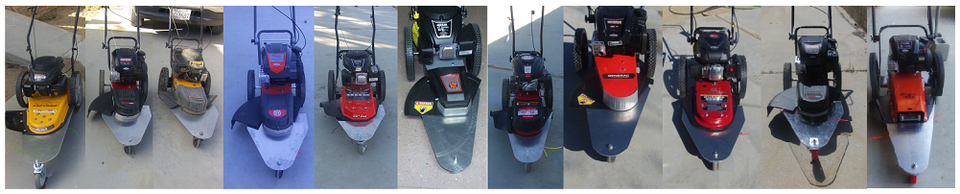
Hands-On Research With 37 Walk-Behind TrimmersMy knowledge did not come from studying only one machine. I personally worked with and studied 37 different walk-behind trimmer models.
I learned how different manufacturers design their frames, how components are arranged, and how each machine performs in real-world conditions. This hands-on experience gave me the knowledge needed to design a practical solution.
The First Working WBTAP Prototype
After tracing the mounting locations, I drilled the holes in the aluminum plate and created a mounting system. I installed a caster swivel wheel using longer bolts and secured the assembly.
Then came the moment of truth. I started the trimmer.
The result amazed me. The trimmer moved forward naturally. I no longer had to constantly press down on the handlebar to control the machine. Maneuvering became easier, and the work could be completed with less effort and strain.
That moment confirmed the idea: adding a third wheel could transform the way people use a walk-behind trimmer.
About WBTAPWork Smarter Not Harder!
WBTAP was created from a simple idea: improve the tools people already use to make their work easier, more comfortable, and more efficient.
We specialize in practical product improvements and engineering solutions that solve real problems experienced by everyday users.
Our Experience
We spent years studying walk-behind string trimmers from many different manufacturers.
We studied how they were designed, how they operated, and the challenges users experienced when controlling and maneuvering these machines.
This hands-on knowledge helped us discover areas where improvements could make a real difference.The Problem We SawMany walk-behind trimmers are powerful tools, but users often struggle with weight and balance Controlling and maneuvering the machine Physical strain during longer jobs Difficulty working around obstacles. The 3rd Wheel Conversion Kit was created to improve the walk-behind trimmer experience.
By adding a third wheel support system, the conversion kit helps transform a traditional two-wheel trimmer into a more stable and easier-to-control machine. The goal is simple:
Reduce effort. Improve control. Make the work easier.
Why We Share Our Knowledge
We do not only sell a product. We educate customers so they can make better decisions when choosing and using walk-behind trimmers.
Our goal is to provide honest information based on real hands-on experience.Our MissionAt WBTAP, we believe innovation should solve real problems.
Our mission is to create practical improvements that help people work safer, easier, and smarter.
Work Smarter, Not Harder.